
Obituaries/Transitions
If you are a SSSP member and would like to post an obituary/transition, please contact the Administrative Office at sssp@utk.edu. Obituaries/Transitions will remain posted for 2 years.
Donileen R. Loseke, 1947-2026
SSSP Past President, 2016-2017, University of South Florida
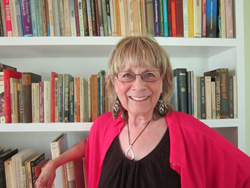 |
It is with a deep sense of sadness and loss that we announce the passing of our friend and colleague, Professor Emeritus Donileen R. Loseke, 79, on Wednesday, September 2, 2026, after a prolonged illness. An intellectual powerhouse and demanding thinker, to her colleagues and friends, she was simply yet iconically Doni.
Doni joined the University of South Florida Department of Sociology (now the Department of Sociology and Interdisciplinary Social Sciences) in 1996, serving as Chair until 2001. Shoring up the department’s early distinction as a center for qualitative sociology, she was instrumental in establishing the reputation of excellence the department now enjoys as an R1, AAU, Ph.D.-granting department. She attained Professor rank in 2002 and served as Graduate Director before retiring in 2019, at which time she served on ¼ of all Ph.D. committees for graduate students in our department.
Doni had previously served in tenure line positions at Skidmore College and State University of New York Geneseo. She was proud to have earned her Ph.D. from the University of California, Santa Barbara in 1982 during a vibrant era of interactionist sociology and ethnomethodology. She was equally proud of the working-class beginnings of her intellectual career following a stint as a bank teller and her interdisciplinary undergraduate training at California State University, Dominguez Hills (B.A. Psychology and M.A. Behavioral Science).
She meticulously penned 5 books, 4 edited collections, and more than 40 articles and book chapters as a founding voice in narrative sociology, sociology of emotions, sociology of social problems, family violence, and social constructionism. Her work emphasizes how social problems are not simply objective conditions but, rather, created through everyday narration of “formula stories.” That is, issues become social problems through processes of interpretation, claims-making, deployment of cultural meanings, and institutional organization. Importantly, she outlined symbolic codes as systems of cognitive meaning—cultural ways of thinking—and emotion codes as systems of emotional meaning—cultural ways of feeling. Narratives become persuasive partly because they reflect and reinforce such broader systems of meaning. She emphasized the power of narratives – what they do – by connecting the ways meanings inform practical consequences. Across this work, she showed how cultural, institutional, and personal stories shape identities and influence public policy and social-service responses.
For her work, she earned the Charles Horton Cooley Award for her book The Battered Woman and Shelters: The Social Construction of Wife Abuse and well as the George H. Mead Lifetime Achievement Award from the Society for the Study of Symbolic Interaction. Among her other major books were Thinking about Social Problems: An Introduction to Constructionist Perspectives (1999), Methodological Thinking: Basic Principles of Social Research Design (2013), and Narrative Productions of Meaning: Exploring the Work of Stories in Social Life (2019). In recent years, she focused her writing on qualitative methodology. She was working on her 10th book when she passed.
Half of an intellectual power couple, Doni married Spencer E. Cahill in 1979, while at UC Santa Barbara. Together and individually, they gained esteem for their scholarship, collegiality, generous service to the discipline, and unwavering mentoring of students and junior faculty. They graciously welcomed new people to the Department, and annual parties at their lovely home strengthened these relationships. Spencer, also Professor of USF Sociology, predeceased her in 2006.
An active member of several academic societies including The Society for the Study of Symbolic Interaction (SSSI), The Society for the Study of Social Problems (SSSP), and The American Sociological Association, Doni gave generously of her intellect, time, and sound leadership for many years, receiving many accolades. Doni was Editor (with Spencer) of Journal of Contemporary Ethnography, and Associate/Deputy Editor of Social Psychology Quarterly, and Symbolic Interaction, in addition to serving on the editorial boards of several journals. She served as President of SSSI in 1997 and of SSSP in 2017. Additionally, she earned mentoring awards from both SSSI and Sociologists for Women in Society.
Born in Omaha, Nebraska, on February 12, 1947, Doni was the oldest of three children of Donald F. and Eileen M. Loseke. She was raised in the Benson area of Omaha before moving with the family to Sedalia, Missouri, and then to Portland, Oregon, where she finished high school. After graduating high school, she moved to California where she completed college and graduate school. She is survived by her sister, Lynnette (John) Gardner of North Carolina, nephews Marty (Kelly), Matthew, and Michael and niece Megan of South Carolina, niece Julie of California, great nieces Maya and Abby and great nephew Dylan, all of South Carolina. Her brother Allan pre-deceased her.
This news brings a deep sense of loss to those of us who knew Doni throughout the various stages of her career and contributions to our discipline and to our department. She served our department in so many ways over the years, and for that we are truly grateful.
We all take great pleasure and solace in imagining Doni and Spencer sitting on a bench in Paris, reunited, and thinking about their next travel adventure and joint sociological research project. This is what they had promised each other.
A service of remembrance with her colleagues will be held later this fall in the Tampa area. For details, please contact Jim Cavendish.
Posted: 09/18/2026
Irwin Deutscher, 1923-2026
SSSP Past President, 1964-65, Syracuse University
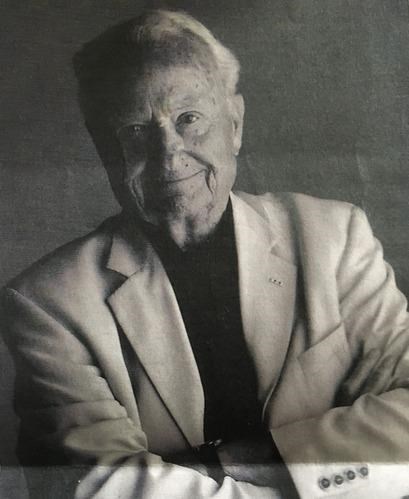 |
Irwin Deutscher born on December 24, 1923, in New York City passed away on April 30, 2026. When he was a child, the family moved from Brooklyn to East Rockaway, on Long Island, New York where he graduated from East Rockaway High School.
After high school, his idea was to leave New York for “somewhere out West.” He enrolled at the University of Missouri. But his college career was interrupted by World War II.
Irwin entered the United States Marine Corps in 1943. He went to boot camp at Paris Island, South Carolina and to further training in Jacksonville, Florida where he learned to be a radioman and rear gunner. He was then selected to attend navigator/bombardier school in Quantico, Virginia, where he was promoted to sergeant.
After he completed his training, he flew to the South Pacific theater where he served in Marine Squadron VMB-413 flying in and navigating the PBJ (B-25 Mitchell) bomber. He flew in the Battle of the Solomon Islands and the Invasion of the Philippines for which he was awarded four Battle Stars, nine Air Medals and two Distinguished Flying Crosses.
After the war, he returned to Mizzou on the G.I. Bill. While in college, Irwin met his future wife Verda Goodman of Vandalia, MO, who was recently discharged from the WW II Women’s Army Corp. With her support, he completed a BA in philosophy, an MS in statistics, an MA in sociology, and a PhD in sociology. The couple worked with students to conduct sit-ins at lunch counters in Columbia MO where many fellow citizens were not being served. The couple continued to actively promote civil rights and social justice causes throughout their lives.
Sociology was Irwin’s career. He was a professor at Syracuse University, Case Western Reserve University, the University of California at both Berkeley and San Diego, and the University of Amsterdam in the Netherlands. He retired from the University of Akron in 1984 as Professor Emeritus. He received postdoctoral fellowships from the National Science Foundation and the National Institute of Health. He is the author of nine books and over a hundred articles and book reviews. Among his honors were the Annandale Memorial Medal for distinguished service to Indian Anthropology, the Noel Gist Award from the University of Missouri and an award from colleagues at the Ohio State University for contributions to students and faculty. He was the recipient of the American Sociological Association’s Distinguished Career Award, and the Lee Founders Award from the Society for the Study of Social Problems.
Irwin and Verda moved to Washington, DC in 1984 where they lived a busy retirement. A single-handed sailor for most of his life, Irwin sailed the American coasts, the Great Lakes and the Baltic Sea. He particularly enjoyed exploring and sailing Chesapeake Bay. As a volunteer, Irwin served as a docent at the Library of Congress where he developed a tour based on the life of Thomas Jefferson. He also played clarinet and saxophone in several Washington area ensembles and was an avid gardener.
Irwin was preceded in death by his wife of 73 years Verda Deutscher. He leaves behind two daughters; Sara Elizabeth Earl (Forrest Earl) of Cortland, NY and Martha Louise Deutscher (Stephen Zvolensky) of Arlington, VA and two grandsons; Elijah Earl (Hannah Liu) of Falls Church, VA and Caleb Earl (Katie Wick Earl) of Buffalo, NY. He will be interred at Arlington National Cemetery at a later date.
Posted: 09/02/2026
Carol Brooks Gardner, 1948-2026
Carol Brooks Gardner, 78, formerly of Berkeley, California, passed away on June 1, 2026 in Indianapolis, where she lived since 1986. She was a professor of sociology at IUPUI for almost thirty years and author of the book Passing By: Gender and Public Harassment, published by University of California Press in 1995.
Carol was born on March 1, 1948, in Newark, New Jersey, to Carl and Alice Pfuderer. She was a graduate of UC Berkeley, where she earned her undergraduate degree in linguistics, and the University of Pennsylvania, where she obtained her PhD in sociology.
Carol is survived by her beloved daughter, Abigail Dembo, and her former husband, William Gronfein.
Carol loved gardening and all animals. She cared deeply about animal rescue. Donations in her memory can be made to PNC Midwest Rescue Community.
Aaron-Ruben-Nelson Funeral Home is handling arrangements.
Posted: 09/02/2026
Glenn A. Goodwin, 1939-2026
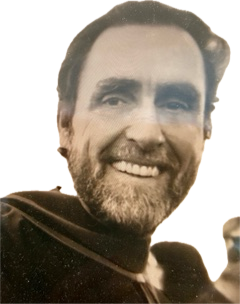 |
Professor Glenn A. Goodwin passed away on March 25, 2026, after a brief illness. Emeriti Professor of Sociology, Pitzer College and University of La Verne, Glenn completed a B.A. in Sociology from S.U.N.Y. Buffalo and recieved his Ph.D. from Tulane University. After taking early retirement from the Claremont Colleges, he was invited to Ohio University and, when he returned to Claremont, joined the University of La Verne faculty. Glenn taught on both the undergraduate and graduate level at a number of Universities in the U.S., as well as in England and the American University in Cairo, Egypt. His major areas of specialization were the history and development of sociological theory, humanistic sociology, sociology through literature, and the sociology of civil liberties.
Glenn’s professional career began during the mid-twentieth-century “crisis” of sociology, with his academic involvement demanding the discipline become more relevant toward addressing the social conflicts of the times. He strongly identified with the “insurgent” Young Turks calling for the discipline’s aggressive reform from its positivist limits of “value free”, overly deterministic, and quantitative orientation.
In this vein, Glenn found his lifelong professional home with the Society for the Study of Social Problems (SSSP), under the direction of Alfred McClung Lee. His esteem for Lee as a mentor, colleague, and friend would remain with him throughout his career. As a regular attendee of meetings for 50 years, participating on numerous committees as well as developing annual meeting sessions, Glenn’s greatest pleasure derived from chairing and participating on the C. Wright Mills Book Award Committee.
In 1976 Glenn became a founding member of the Association for Humanist Sociology, and developed a value-oriented methodological paradigm for humanist sociology; placing primary emphasis upon individual agency, human potential, and the ethical pursuit of meaning and social justice as cornerstones to all sociological inquiry.
The recipient of a number of excellence in teaching awards, Glenn derived his highest professional honor from his calling as a teacher. Throughout his teaching and scholarship, Glenn sought to intertwine the humanist contributions of existentialism and symbolic interactionism with his sociological orientation by understanding society from the perspective of individual-lived experiences, emotions, and creativity. Seeking to awaken in young minds the quest for understanding the world and their purpose in it, he lectured through the lens of the sociological imagination, whereby personal troubles were better understood as public issues, thus enabling one to achieve personal agency over their lives and the social forces which sought to control them.
Above all else, it was through his gentleness, kindness, and open willingness to engage with his students by listening and hearing their points of view without judgement, no matter how divergent they were, that gave him joy as a teacher. His purpose as a teacher was to endeavor to stitch together meaning for his students in a world filled with contradictions and absurdity.
Toward the end of his career, Glenn was confronted with the greatest Sisyphean absurdity of his professional life; the demise of classical sociological theory from undergraduate and graduate programs throughout the nation. No longer are the foundational works of Marx, Durkheim, and Weber deemed significant enough to be universally required study for degrees in Sociology. Nonetheless, his 2006 capstone book, “Classical Sociological Theory: Rediscovering the Promise of Sociology”, co-authored with friend and colleague, Joseph Scimecca, is still in publication — a testimonial to the endurance of the need for intellectual authenticity and commitment to humanist values.
As a corollary to “that old gadfly of Ancient Athens who said “the unexamined life is not worth living”, for Glenn the secret of human meaning lay in devoting one’s life to asking the questions: what is the secret of human meaning and how does one live a meaningful life? This quest infused his 53 years of professional teaching and scholarship, and activism as a civil liberties and civil rights advocate. Glenn is survived by his wife, and intellectual partner of 49 years, Rose Ash of Claremont, CA.
Posted: 7/29/2026
Kai T. Erikson, 1931-2026
SSSP Past President, 1970-1971, Yale University
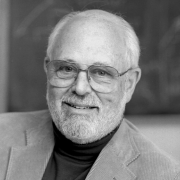 |
Kai T. Erikson, a sociologist who examined the aftermaths of floods, nuclear accidents, hurricanes and chemical spills to illustrate how disasters damage what he called the “tissues of communal life,” inflicting collective trauma that can outlast physical wounds, died on Nov. 10 in Hamden, Conn. He was 94.
His death, at a retirement home, was announced by Yale University, where he taught from 1966 to 2000.
Professor Erikson worked in the academic shadow of his father, the renowned psychoanalyst Erik Erikson, a Sigmund Freud disciple whose psychosocial development theory described a series of internal psychological crises that individuals face throughout their lives.
Aiming his own analytical lens outward, Professor Erikson probed the social and cultural trauma that is visually imperceptible after natural and man-made disasters, traveling so frequently to far-flung calamities that The Times of London called him “Professor Catastrophe From America.”
“Collective trauma works its way slowly into the awareness of those who suffer from it, so it does not have the quality of suddenness usually associated with ‘trauma,’” he wrote in “The Sociologist’s Eye: Reflections on Social Life” (2017). “But it is a form of shock all the same, a gradual recognition that the community no longer exists as a source of support or solace.”
Professor Erikson became interested in disasters by accident.
In 1973, he received a call out of the blue from a lawyer representing residents of Buffalo Creek, W.Va., a coal mining community where a dam had failed, unleashing 132 million gallons of thick black liquid that gushed through a narrow mountain hollow in waves 20 feet high. More than 100 people died. Thousands were left homeless.
The lawyer asked Professor Erikson if he knew a graduate student who might be willing to spend a semester studying the aftermath. “I told him over the phone that I could make a more informed recommendation if I saw the site myself,” Professor Erikson wrote.
After a few hours looking around Buffalo Creek, he took the job.
“I had never seen or even imagined anything remotely like that — desolate, dark, a scene of such heavy, muted pain that I have a hard time finding words to capture it decades later,” he wrote. “I was drawn to the place as if by a compulsion.”
Professor Erikson spent more than a year interviewing survivors, reviewing legal depositions, attending community meetings and observing daily life as residents struggled to rebuild their homes and their way of living.
He detailed their struggles in “Everything in Its Path: Destruction of Community in the Buffalo Creek Flood” (1976), a mix of social science, narrative journalism and oral history. It was a finalist for the National Book Award in the contemporary thought category.
“Social scientists will, I hope, take note of the vitality and creativity of which their discipline is capable,” the author and political activist Michael Harrington wrote in The New York Times Book Review. “Nonacademic readers will encounter an exciting, enriching book.” He called it “a triumph of contemporary understanding.”
In the book, Professor Erikson let Buffalo Creek residents speak in their own voices, rather than paraphrasing them in academic jargon.
“The flood in its own way destroyed my past in the mental sense,” one said. “I knew everybody in the area. That’s where I lived, and that’s what I called home. And I can’t go back there anymore. I can’t even think of it. I have no past.”
To Professor Erikson, the physical damage and psychological displacement amounted to a “loss of flesh” — an acute trauma that becomes an ongoing state of mind, with permanent feelings of despair, anguish and emptiness.
“When the people of Buffalo Creek stood there and watched their possessions crash down the hollow, they were watching a part of themselves die,” he wrote. “To lose a home or the sum of one’s belongings is to lose evidence as to who one is and where one belongs in the world.”
Over the next 40 years, Professor Erikson traveled the world to embed himself in the aftermath of catastrophic events — a mercury spill in Ontario, the nuclear reactor accident in Three Mile Island, Pa., the Exxon Valdez oil spill in Alaska the flooded streets of New Orleans after Hurricane Katrina and other tragedies.
Professor Erikson’s instinct to immerse himself in the places he wrote about was a throwback to the early days of sociology, when research was grounded in lived experience rather than the quantitative statistics and technical theory that pervades the field today.
“He was concerned with broad problems and big ideas, and he wrote about them beautifully,” Jeffrey Alexander, a sociologist at Yale, said in an interview. “You learn a lot about social order when it is very abruptly and visibly destroyed. You understand what really ties society together.”
Professor Erikson often testified in court on behalf of victims.
“Legend has it that his powerful presence and voice became so well-known and feared by opposing counsel that once, when he was seen to enter a courtroom for the defense unannounced, the other side immediately settled,” Yale said in announcing his death.
Kai Theodor Homburger was born on Feb. 12, 1931, in Vienna, Austria, to Erik and Joan (Serson) Homburger.
After the family immigrated to the United States in the early 1930s, Kai was reportedly taunted at school and called “Hamburger” by other students. His parents decided to change their last name.
Kai was studying sociology at Reed College in Portland when his father’s best-known book, “Childhood and Society,” was published in 1950. After graduating in 1953, he received his master’s degree and doctorate from the University of Chicago.
With an interest in field work, he spent several months immersing himself in a Polish community in South Chicago.
“That experience of the ‘feel of the streets’ made a deep impression on me, and it played a far greater role than I realized at the time in influencing my sense of what ‘social life’ really is and how one might go about studying it,” he wrote in “The Sociologist’s Eye.”
Before turning to disasters, he wrote “Wayward Puritans: A Study in the Sociology of Deviance” (1966), examining how deviant behavior “can sometimes be a valuable resource in society, providing a point of contrast, necessary for the maintenance of a coherent social order.”
Professor Erikson married Joanna Slivka in 1961. She survives him, along with their sons, Keith and Christopher Erikson; a sister, Sue Erikson Bloland; and four grandchildren.
At Yale, Professor Erikson was to his admirers a lot like the inspirational teacher played by Robin Williams in the 1989 movie “Dead Poets Society” — though he wasn’t given to spouting poetry while standing on desks.
His former student, the author and political satirist Christopher Buckley, remembered him in an interview as the “Pied Piper.”
“We started a cult of Kai Erikson without him really knowing it,” Mr. Buckley said, recalling how he and his roommates, the future New York Times journalists Michiko Kakutani and John Tierney, went so far as to tape his discarded cigarette butts to their refrigerator.
They even staged a festival in his honor on their front lawn.
“It was just a funny concept that Kai Erikson was a god,” Mr. Buckley said, “and yet he was also this humble professor.”
Read the obituary on New York Times and In Memoriam published in Yale News.
Posted: 03/31/2026
James D. Orcutt, 1943-2026
SSSP Past President, 1994-1995, and Editor of Social Problems, 1984-1987, Florida State University
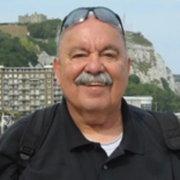 |
James (Jim) D. Orcutt, age 82, died peacefully at home in Tallahassee on February 25, 2026, after a long illness. His wife and devoted caregiver, Annette, was at his side, along with his brother-in-law, Ray, and sister-in-law, Pat. Jim was raised in Des Moines, Iowa, and was predeceased by his parents, Albert and Doris Orcutt, and siblings David Orcutt and Phyllis Bergeson. He is survived by his sister, Kate Capps; wife, Annette Schwabe; daughter, Michelle Orcutt; stepson, Derek Schwabe-Warf (Dori Ballai); sisters- and brothers-in-law; and many nieces, nephews, and friends. After completing his bachelor’s and master’s degrees in sociology from the University of Iowa Jim served as a psychiatric operations specialist in the army. He earned a PhD from the University of Minnesota and began his research and teaching career in the Sociology Department at Florida State University in 1972 and retired as Professor Emeritus in 2007.
Jim was an accomplished scholar, a devoted instructor, an effective administrator, and a generous colleague. He wrote two books and scores of journal articles in his specialty areas of deviance and drug and alcohol problems. He served as department chair, engaged in extensive university service, taught multiple undergraduate and graduate courses in his specialty areas and received departmental and university teaching awards. He also served as a grant reviewer for several organizations. Jim was a beautiful writer, and his willingness to pass on editing tips and intellectual critiques was much appreciated by his colleagues. His election to the presidency of the Society for the Study of Social Problems and his appointment as editor of the journal Social Problems signify the high regard in which the profession held him and his dedication to advancing the field of sociology.
Jim was a loving and warm spouse, brother, father, and friend. He was an accomplished musician and had a wonderful sense of humor, a deep curiosity about the world and other people, and a strong sense of justice. He will be dearly missed by so many, but we are grateful for his beautiful presence in our lives.
Jim will continue to serve students through the Florida Anatomical Donation program, which supports medical training and research to facilitate advancements in health. Donations to honor Jim may be made to the FSU Department of Sociology, Big Bend Hospice, Epilepsy Agency of the Big Bend, RBG Fund, Refuge House, or https://riseinternational.org.
Breanna Green of Bevis Funeral Home (850-385-2193 or www.bevisfh.com) is assisting the family with their arrangements.
Posted: 03/9/2026
Brett Lesley Cumberbatch, 1983-2025
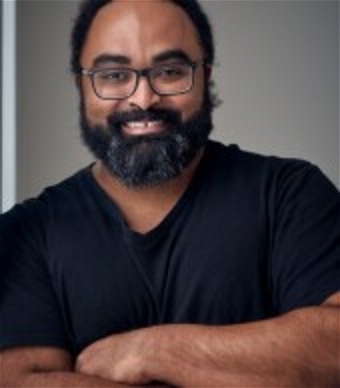 |
We are saddened to share the passing of one of our members. Click here to read his obituary.
Posted: 03/17/2025
Find Archived Obituaries/Transitions Here.
