Global Agenda for Social Justice
President's Welcome
The Society for the Study of Social Problems has for 75 years sought to better understand, solve and prevent social problems. While there has never been a shortage of social problems, there are many indicators that we are currently facing once unfathomable crises at local, regional, national, and global levels. We are at a critical moment in the lifeworlds of our global and local communities.
Sociologists and activists have continued to develop ways of conceptualizing and responding to social problems. While some have created frameworks to address particular problems, others have sought ways to better understand a wide range of contemporary problems in our social worlds. Some of today’s most pressing social problems represent long- standing challenges to humanity’s impact on the natural, animal, and social worlds, and some are consequences of earlier, intentionally coercive and exploitative, illconceived, or failed attempts to solve social problems, such as criminalization and medicalization.
At our 2026 Annual Meeting, we are guided by the theme ‘Resisting Colonization of Lifeworlds.’ We view this theme as broadly applicable to many of the global social problems we are currently facing that are illuminated in this volume. Oppressive and dominating processes of colonization objectify and exploit humanity, animals, and our natural world. Chapters in this volume address such processes, including the criminalization of poverty and mental illness, the exploitation of workers in impoverished countries through globalization, and the objectification and dehumanization of immigrants.
Authors in this edition discuss the commodification of and profiting from human needs like menstruation; the financialization of housing; professionalization of various fields and disciplines to control training, access, and entry; and the exploitation of our natural resources to maximize profit. Many also focus on active resistance, resilience, empowerment, and humanization.
On behalf of the SSSP, I would like to thank the editors and contributors to this volume for their commitment to addressing social problems in our world through their scholarship and activism. I invite you all to join this resistance through your networks and communities, using the resources at your disposal, in solidarity with others seeking a better world.
Sarah Jane Brubaker, Virginia Commonwealth University
SSSP President, 2025-2026
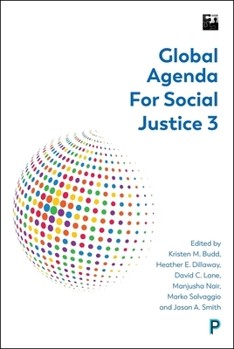
The Global Agenda for Social Justice 3 provides accessible insights into some of the most pressing social problems and proposes public policy responses to those problems.
Written by a highly respected team of authors brought together by the Society for the Study of Social Problems (SSSP), the book offers recommendations for action by elected officials, policy makers, and the public regarding key issues for social justice. Chapters include discussion of social problems related to period poverty, climate justice, algorithmic bias, labor rights, and global inequality.
The book will be of interest to scholars, practitioners, advocates, and students interested in public sociology, the study of social problems, and the pursuit of social justice.
Access Options
The Global Agenda for Social Justice 3 is now available for wide public distribution
As a benefit for all current SSSP members, a gratis electronic copy of the Global Agenda for Social Justice 3 is provided. You will be required to log in using your e-mail and password. If you have forgotten your password, you may enter your e-mail address below the login area, and your password will be e-mailed to you. If you have recently changed your e-mail address, you will need to login using the address SSSP has on file for you. If you have any questions or need assistance, please contact SSSP at sssp@utk.edu.

Purchasing Options
The Agenda is available in paperback copy and e-reader versions for a nominal fee. Please consider purchasing the Agenda to support the SSSP! Policy Press offers 25% off all books to SSSP members throughout the year with the code SSSP26.
Policy Press purchasing information
Table of Contents
Editors: Kristen M. Budd, Heather Dillaway, David C. Lane, Manjusha Nair, Marko Salvaggio, and Jason A. Smith
|
FRONT PIECES |
|
President’s Welcome |
|
SECTION I CRIME, JUSTICE, AND GOVERNMENT |
|
Chapter 1. Gangs and the Anti-Gang Problem |
|
Chapter 2. The Intersection of Mental Health and Criminal Justice Systems |
|
Chapter 3. Strategies to Improve Access to Justice: Legal Literacy and Legal Empowerment |
|
Chapter 4. Algorithmic Bias in Governance: Reasons and Responses |
|
SECTION II INEQUALITIES AND INJUSTICES |
|
Chapter 5. A Global Agenda for Gender Justice in STEM |
|
Chapter 6. Period Poverty and Menstrual Health in a Global Context |
|
Chapter 7. Global Learning Poverty and Household Welfare |
|
Chapter 8. Climate Change, Vulnerability, and Justice in India: A Review |
|
SECTION III LABOR AND HOUSING INSECURITY |
|
Chapter 9. The Affordable Housing Crisis as a Global Social Problem |
|
Chapter 10. Precarious Labor and the Global Sports Event Industry |
|
Chapter 11. Improving the Working Conditions of Global Garment Workers |
|
SECTION VI REFLECTIONS |
|
Chapter 12. Rethinking Cosmopolitanism: Insights from Migrant Mobilities |
|
Chapter 13. The Rules of Remembrance for Public Sociologists |
|
Chapter 14. Afterword |
